
Geissele Super Duty MOD1 vs. Knights Armament KS1
Quick Overview
Priced around $1,900–$2,425 street/MSRP for a complete Geissele Super Duty MOD1 (13.9″ or 14.5″ pinned-and-welded) and $3,600–$4,900 for a complete Knights Armament KS1 13.7″, these two rifles sit at the top of the premium 5.56 AR-15 market in 2026—but they get there in very different ways. The Geissele Super Duty MOD1 is Geissele’s current flagship fighting rifle: a fully assembled, factory-tuned package built around a cold-hammer-forged chrome-lined barrel, Nanoweapon-coated Reliability Enhanced BCG with Stressproof bolt, SSA-E X two-stage trigger, MK16 Super Modular Rail, Super 42 buffer system, and a pinned HUXWRX Flash Hider-QD. It is the “buy once, shoot everything” premium DI rifle for shooters who want Geissele internals without building a rifle from scratch.
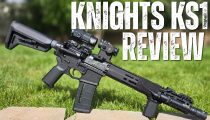
The Knights Armament KS1 is the refined evolution of the SR-15 / SR-16 series and the commercial counterpart to the British L403A1 Alternative Individual Weapon. Selected in 2023 for the Army Ranger Regiment and elements of the Royal Marines, it prioritizes suppressed reliability, heat-stable accuracy, and fully ambidextrous controls in a compact 13.7″ package with a dimpled heavy CHF barrel, URX 6 handguard, and E3.2 dual-ejector bolt.
Both deliver professional-grade performance. The Super Duty MOD1 wins on completeness, parts availability, and value. The KS1 wins on military pedigree, full ambi controls, and suppressor-first reliability. There is no casual overlap—these are two different answers to the same hard-use problem.
Key Specs & Features
| Feature | Geissele Super Duty MOD1 | Knights Armament KS1 |
|---|---|---|
| Platform | Super Duty forged receiver set (MOD1-A optional billet ambi lower) | SR-15 E3.2 / KS-series |
| Barrel | 13.9″ or 14.5″ CHF chrome-lined Geissele tapered profile, 1:7 twist, pinned & welded HUXWRX | 13.7″ CHF chrome-lined heavy dimpled profile (32CrMoV12-10), 1:7 twist, QDC 3-prong |
| Gas System | Mid-length with Super Compact gas block and tuned port (.079″ on 13.9″; .076″ on 14.5″) | Proprietary mid-length optimized for suppressors |
| Handguard | 12.9″ (13.9″ rifle) or 13.5″ (14.5″ rifle) MK16 Super Modular Rail with center-tab lockup and stainless QD inserts | 13″ URX 6 free-float M-LOK (self-indexing) |
| Caliber | 5.56 NATO / .223 | 5.56 NATO / .223 |
| Bolt / BCG | Nanoweapon Reliability Enhanced BCG with forged Stressproof bolt (Carpenter 158+, HPT/MPI) | E3.2 dual-ejector with lobster-tail extractor |
| Controls | Super Configurable Safety, maritime bolt catch, Airborne Charging Handle (not fully ambi mag/bolt) | Fully ambidextrous bolt release, selector, and mag release |
| Trigger | SSA-E X two-stage with Lightning Bow | Drop-in two-stage match |
| Weight | 13.9″ ~6.65 lbs; 14.5″ ~6.7 lbs (unloaded) | ~6.88 lbs (unloaded) |
| Finish | Black or DDC anodize | Black anodize (Cerakote / FDE options exist on the secondary market) |
| Other | Super 42 braided spring + H2 buffer, A17 grip, B5 Enhanced SOPMOD, HUXWRX QD flash hider | QDC 3-prong flash eliminator, full ambi lower, UK L403A1 lineage |
Build Quality & Components
Both rifles are assembled to a standard well above a typical $1,200–$1,800 factory AR. The difference is philosophy.
The Geissele Super Duty MOD1 is a complete in-house system. The CHF chrome-lined barrel, Super Compact gas block, REBCG, Super 42 spring, and SSA-E X trigger are designed to work together rather than as a pile of popular aftermarket parts. Geissele markets the Stressproof bolt as significantly more fatigue-resistant than a standard mil-spec Carpenter 158 bolt, and both the barrel and bolt are HPT/MPI. The MK16 rail uses a center-tab interface that resists rotation better than a generic barrel-nut rail. MOD1 updates over the original Super Duty include the factory HUXWRX Flash Hider-QD, stainless press-fit QD cups in the rail, A17 grip, and QD end plate. Availability is the practical advantage: 11.5″ pistols, 13.9″ P&W rifles, 14.5″ P&W rifles, and 16″ rifles are all part of the same family.
The Knights KS1 is a military contract rifle sold in civilian form. The 13.7″ dimpled heavy barrel is built from 32CrMoV12-10 and cold-hammer-forged for high-volume fire with minimal point-of-impact shift when hot. The URX 6 is self-indexing and extremely shift-resistant. The E3.2 bolt—dual ejectors, lobster-tail extractor, stress-relieved lugs—is the feature most people buy the rifle for, especially suppressed. Fully ambidextrous controls are not an accessory package; they are part of the receiver. Fit, finish, and proprietary lockup are excellent. The tradeoff is cost and parts scarcity: bolts, gas parts, and handguards are KAC-specific and expensive when they appear.
Standout Features — SSA-E X, Stressproof Bolt & MK16 (Super Duty) vs. Dimpled Barrel, Dual Ejectors & Full Ambi (KS1)
The Super Duty’s biggest advantages are the factory trigger, the tuned gas/buffer package, and the fact that almost every wear item is a Geissele part you can actually buy. The SSA-E X with Lightning Bow is still one of the best two-stage triggers that ships in a complete rifle. Combined with the Super 42 spring and a conservatively ported mid-length system, the MOD1 is famously soft for a non-adjustable DI gun. The HUXWRX muzzle device makes Flow-through cans a drop-on accessory instead of a gunsmith job. For most civilian owners, that combination of shootability and serviceability is the entire point of paying $2,000+ for a factory AR.
The KS1’s standouts are the barrel, the bolt, and the controls. Ball-mill dimpling takes weight out of a heavy profile without giving up the thermal mass that keeps zero during sustained fire. Dual ejectors and the lobster-tail extractor are why British special operations selected it after Project Hunter and why it has a reputation as one of the most reliable suppressed short-barreled 5.56 platforms available. Full left-side bolt release, selector, and magazine release matter if you shoot support-side, run night vision, or just refuse to fight a right-hand-only lower. The QDC flash hider is built for KAC’s own suppressor family, not HUXWRX.
Accuracy & Performance
Both rifles are capable of true 1–1.5 MOA with quality 69–77 gr match ammunition and consistent 1.5–2 MOA with service ammo when the shooter and optic are doing their jobs. Neither is a benchrest gun. Both are fighting rifles that happen to group well.
The Super Duty’s tapered CHF barrel and SSA-E X make it easy to shoot well. Published 100-yard testing on MOD1 guns commonly lands in the 1.5 MOA range with 77 gr match and high-1s with 62 gr. The mid-length gas system and Super 42/H2 setup produce a flat, linear recoil impulse that stays controllable in rapid strings. The 14.5″ configuration adds a clear velocity bump over the KS1’s 13.7″; the 13.9″ P&W sits in between and remains a legal rifle in most states. HUXWRX Flow cans pair naturally with the factory muzzle device and keep the gun from becoming a gas cannon.
The KS1’s heavy dimpled barrel is the more heat-stable of the two. Users and military evaluations consistently report less point-of-impact shift after high-round-count strings. The proprietary mid-length gas system and E3.2 bolt make suppressed running the rifle’s natural habitat—especially with KAC QDC/MCQ-PRT or similar low-backpressure cans. Recoil is soft, extraction is authoritative, and ejection stays consistent when the gun is dirty and the can is hot. The shorter 13.7″ tube gives up some velocity to a 14.5″ Super Duty, which is the one ballistic argument that actually favors Geissele in a head-to-head.
Real-World Durability
Geissele built the Super Duty as a duty rifle, not a range toy. CHF chrome-lined barrels, HPT/MPI Stressproof bolts, pinned Super Compact gas blocks, and Nanoweapon coatings are all aimed at high round counts and ugly environments. The platform has a large civilian and law-enforcement following and a long parts pipeline. Isolated QC complaints exist in any high-volume premium line (gas-key staking and occasional chamber variance show up in forum lore), but the overall reliability record is strong when the rifle is maintained like a fighting gun.
Knight’s Armament has a multi-decade reputation for rifles that survive military abuse. The KS1 is not a catalog experiment; it is the rifle the UK issued as the L403A1 after beating HK, SIG, Daniel Defense, and others in Project Hunter. Chrome-lined hammer-forged barrel steel, the E3.2 bolt, and the URX 6 interface were designed around sustained fire, suppressors, dirt, and cold-weather evaluations. Civilian owners pay for that pedigree and for parts that are harder to source. If the mission is “this rifle may be the only one I have,” KAC’s field history is the stronger resume.
Pros and Cons
Pros – Geissele Super Duty MOD1
- Best complete factory package in this price class (trigger, BCG, rail, buffer, muzzle device)
- Excellent value at $1,900–$2,425 vs. $3,600+
- SSA-E X Lightning Bow trigger is a genuine advantage
- Soft, well-tuned mid-length + Super 42 recoil impulse
- 13.9″ and 14.5″ P&W configs are legal rifles in most states
- HUXWRX QD muzzle device is suppressor-ready out of the box
- Parts and complete uppers are far easier to buy than KAC
- Multiple barrel lengths in one family (11.5″, 13.9″, 14.5″, 16″)
Cons – Geissele Super Duty MOD1
- Not fully ambidextrous (safety + ACH + maritime catch only)
- No equivalent to the E3.2 dual-ejector bolt
- MK16 is excellent but not as “monolithic-rigid” as some modern rails
- HUXWRX flash hider can feel lively unsuppressed
- Standard MOD1 lower is forged mil-spec, not a full ambi billet set (MOD1-A costs more)
- Less formal military-adoption pedigree than the KS1 / L403A1
Pros – Knights KS1
- Exceptional suppressed reliability (E3.2 dual ejectors)
- Fully ambidextrous controls
- Minimal POI shift when hot (dimpled heavy barrel)
- Proven military adoption (UK L403A1)
- Soft-shooting proprietary mid-length gas system
- URX 6 self-indexing rail and KAC QDC suppressor ecosystem
- Premium fit, finish, and brand pedigree
Cons – Knights KS1
- Much higher street price ($3,600–$4,900 complete is common)
- Proprietary bolt, gas system, and handguard are expensive to replace
- 13.7″ is typically an SBR or pistol—NFA unless you buy a 16″ KS variant
- Limited availability and high demand
- Heavier profile barrel retains more heat under the handguard
- Slightly lower velocity than a 14.5″ Super Duty
Final Verdict
The Geissele Super Duty MOD1 and Knights Armament KS1 13.7″ are two of the best hard-use 5.56 ARs you can buy in 2026. They are not interchangeable.
Choose the Super Duty MOD1 if you want the best factory-complete rifle under $2,500, a legal 13.9″ or 14.5″ pin-and-weld configuration, a trigger that does not need to be swapped, and a gun you can actually support with spare BCGs, springs, and uppers. It is the smarter rifle for most serious civilians, instructors, and agencies that need performance without KAC pricing.
Choose the KS1 if you prioritize maximum suppressed reliability, full ambidextrous controls, heat-stable zero, and a rifle that already survived a national SOF downselect. It is the rifle for buyers who specifically want the L403A1 experience and are willing to pay for proprietary parts and NFA paperwork on the 13.7″ gun.
If budget is the tie-breaker, the Super Duty wins easily. If “this is the last AR I intend to own and I shoot suppressed,” the KS1 still has a case. Both will outlast most owners. Buy the one that matches your legal configuration, suppressor plan, and tolerance for proprietary parts—not the one with the louder internet reputation.
Frequently Asked Questions
What is the street price difference between the Super Duty MOD1 and the KS1?
A complete Super Duty MOD1 typically runs $1,900–$2,425 depending on barrel length and color (black is often cheaper than DDC). A complete KS1 13.7″ commonly sells between $3,600 and $4,900. The Geissele is the clear value; the Knights costs roughly two Super Dutys before optics.
Which barrel length should I compare?
The fair fight is KS1 13.7″ vs Super Duty 13.9″ P&W. The 14.5″ Super Duty is the better velocity/legal-rifle option. Geissele also offers 11.5″ pistols and 16″ rifles in the same family; KAC offers other KS-series lengths, but the 13.7″ is the L403A1 analog.
Which is better suppressed?
The KS1 has the edge because of the E3.2 dual-ejector bolt and a gas system designed around KAC QDC suppressors. The Super Duty still runs very well with HUXWRX Flow-series cans thanks to conservative porting and the factory QD flash hider. If suppression is the primary use case and money is secondary, KS1. If you want a Flow can on a legal 14.5″ rifle, Super Duty is the cleaner setup.
Do I need an SBR tax stamp for either?
The popular KS1 13.7″ is typically an SBR or pistol. The Super Duty 13.9″ and 14.5″ models ship pinned and welded to a legal 16″ overall barrel length, so they are standard rifles in most states. Geissele 11.5″ guns are pistols or SBRs.
Is the Super Duty fully ambidextrous?
No. Standard MOD1 rifles get a Super Configurable Safety, maritime bolt catch, and Airborne Charging Handle. Magazine release and bolt release are not fully mirrored like the KS1. Geissele’s MOD1-A adds a billet ambi lower at a higher price if that is a requirement.
Are parts interchangeable with standard AR-15s?
The Super Duty uses far more standard-dimension parts (buffer, spring, trigger pins, magazines, many small parts). The KS1 has several proprietary components (E3.2 bolt, gas system, URX 6, ambi controls), so replacements are specialized and expensive.
Which has the better trigger?
Most shooters will prefer the Geissele SSA-E X. It is one of the reasons people buy a Super Duty instead of building one. The KS1’s factory two-stage is good and duty-appropriate; it is not the same shooting experience as an SSA-E X.
Which should I buy in 2026?
If you want maximum performance per dollar, a legal pin-and-weld rifle, and parts you can replace next year → Super Duty MOD1. If you want full ambi controls, the L403A1 pedigree, and the most proven suppressed short-barreled KAC package → KS1. For most buyers, the Super Duty is the rational choice. For a specific SOF-clone or suppressor-first build, the KS1 is still the one.