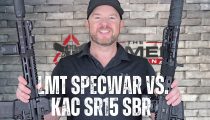

LMT SPECWAR VS Geissele Super Duty MOD1
Quick Overview
Priced around $2,600–$2,850 street for a complete LMT SPECWAR 12.5″ SBR and $1,900–$2,375 for a Geissele Super Duty MOD1 14.5″ pinned-and-welded rifle, these two platforms sit at the top of the modern hard-use 5.56 AR-15 market in 2026. Both are excellent. Only one is the more complete fighting rifle.
The LMT SPECWAR 12.5″ is Lewis Machine & Tool’s purpose-built special warfare carbine: an MRP-L monolithic upper paired with a fully ambidextrous MARS-L lower, developed with input from U.S. special operations warfighters—including Air Force Special Warfare. It prioritizes the things that actually matter when the rifle is a tool instead of a parts list—rail rigidity for lasers and night vision, mid-length reliability in a compact 12.5″ package, true quick-change barrel modularity, and full ambidextrous controls.The Geissele Super Duty MOD1 14.5″ is Geissele Automatics’ current flagship complete rifle and the commercial cousin of the USASOC URG-I family. It is beautifully finished, soft-shooting, and loaded with class-leading small parts: SSA-E X trigger, Stressproof Reliability Enhanced BCG, Super 42 buffer system, and a center-tab MK16 rail. It is an outstanding rifle. It is also a conventional two-piece AR wearing better furniture.If the question is “which one would I rather take seriously,” the SPECWAR wins. The Geissele is the better catalog package. The LMT is the better weapon.
Key Specs & Features
- Platform: LMT – MRP-L monolithic upper + MARS-L ambi lower; Geissele – Super Duty forged M4 upper + Super Duty mil-spec lower
- Barrel: SPECWAR – 12.5″ chrome-lined, cryogenically treated, mid-length 5.56 NATO, 1:7 twist, proprietary MRP quick-change; Super Duty – 14.5″ cold hammer forged, chrome-lined, Geissele tapered profile, 1:7 twist, pinned & welded HUXWRX Flash Hider-QD
- Gas System: Both mid-length (SPECWAR short-dwell / purpose-ported for 12.5″; Super Duty .076″ port with Super Compact gas block)
- Handguard: SPECWAR – 11.5″ monolithic M-LOK (one-piece with upper, continuous top Picatinny); Super Duty – 13.5″ MK16 Super Modular Rail with Geissele center tab and stainless QD inserts
- Caliber: Both 5.56 NATO / .223 (LMT MRP barrels also support .300 BLK and other compatible MRP barrels)
- Bolt / BCG: SPECWAR – full-auto profile M16 BCG (LMT enhanced bolt available/upgradable); Super Duty – Nanoweapon-coated Reliability Enhanced BCG with Stressproof bolt (HPT/MPI)
- Controls: SPECWAR – Fully ambidextrous MARS-L (selector, mag release, bolt catch/release) + ambi charging handle; Super Duty – Super Configurable Safety, maritime bolt catch, Airborne Charging Handle
- Trigger: SPECWAR – LMT AXLE two-stage; Super Duty – SSA-E X two-stage with Lightning Bow
- Weight: SPECWAR ~6.4–7.0 lbs; Super Duty 14.5″ ~6.7 lbs (unloaded)
- Finish: Both black anodized (FDE / DDC options available)
- Other: SPECWAR – two T-30 barrel locking bolts + SOPMOD stock; Super Duty – Super 42 braided spring + H2 buffer, B5 Enhanced SOPMOD, Geissele A17 grip
Build Quality & Components
Both rifles sit in the premium tier and reflect real military contract experience. The difference is where each company spent the engineering.
The LMT SPECWAR is built around the patented Monolithic Rail Platform. Receiver and handguard are machined from a single aerospace-grade aluminum forging. There is no barrel nut joint. There is no clamp-on rail that can twist under a PEQd-up night setup. The barrel locks in with two side-access T-30 bolts and a full 360° engagement on the barrel extension. Pull that barrel, put the same one back, and it returns to zero. That is not a convenience feature—it is why the chassis exists. The 12.5″ chrome-lined mid-length barrel is cryo-treated and deliberately short-dwell, which keeps a compact gun reliable and controllable, including suppressed. The MARS-L lower is one of the few truly full-ambi forged lowers on the market: selector, magazine release, and bolt catch/release are bilateral and machined into the receiver. That matters the first time you run the gun support-side, off a barricade, or under nods. Furniture is LMT SOPMOD. The factory AXLE two-stage is a duty trigger, not a match trigger. It is good enough to leave alone.The Geissele Super Duty MOD1 takes the opposite approach and does it extremely well. It is a conventional forged receiver set packed with best-in-class small parts that are already matched to each other. The 14.5″ CHF chrome-lined barrel, MK16 rail with center-tab lockup, Reliability Enhanced BCG, Super 42/H2 buffer, Airborne Charging Handle, and SSA-E X trigger make it one of the most complete rifles you can buy without building anything. That is a genuine strength. It is also why some shooters call it the winner on paper. The Super Duty is a superb AR-15. It is not a more rigid rifle, it is not a more ambidextrous rifle, and it is not a more modular rifle. Those three things are the SPECWAR’s entire reason for existing.
Standout Features — Monolithic MRP & Full Ambi (SPECWAR) vs. SSA-E X, Stressproof BCG & MK16 (Super Duty)
This is where the comparison stops being close.
The SPECWAR’s advantages are structural. A true one-piece upper/handguard is still the most rigid way to hang a laser, illuminator, and clip-on NV device on a short fighting rifle. That is not marketing. Flex in a two-piece rail shows up as wandering IR zeros, not as a feeling on the bench. The quick-change MRP barrel system is equally serious: one chassis can run 12.5″ 5.56, a longer 5.56 tube, or a .300 BLK barrel with a T-30 bit and return-to-zero on the same barrel. Combined with the MARS-L lower, the SPECWAR is the more complete control layout for actual fighting use—support-side shooting, weak-hand reloads, and night work.The Super Duty MOD1’s standouts are refinement. The SSA-E X is the better trigger. The CHF barrel and tuned .076″ mid-length port plus Super 42/H2 give a very consistent recoil impulse. The pinned-and-welded HUXWRX Flash Hider-QD makes the 14.5″ a legal rifle and pairs cleanly with FLOW cans. The MK16 is a proven rail. None of that is trivial. It also does not close the gap on chassis rigidity, full ambidexterity, or barrel modularity. Geissele built the nicer conventional AR. LMT built the better fighting architecture.
Accuracy & Performance
Both rifles will outshoot most owners. With quality 69–77 gr match ammunition, the Super Duty often has a slight edge in raw group size because of the CHF tapered barrel and the SSA-E X trigger. That is real. It is also the least important part of this comparison. Practical accuracy on both guns lives in the same neighborhood: roughly 1–1.5 MOA with good ammo, with the Geissele more likely to print the occasional tighter group and the LMT living comfortably in the 1–2 MOA service-rifle window while staying consistent when the barrel is hot.
On the gun, the SPECWAR is the more interesting shooter. Mid-length gas on a 12.5″ barrel is the entire Specwar spec. Dwell time stays short, the impulse stays controllable, and the gun remains compact enough to fight inside vehicles, structures, and around armor. That 12.5″ length is not a compromise against a 14.5″—it is the point. You give up some velocity. You gain a rifle that handles like a fighting carbine instead of a recce gun wearing a shorter stock.The Super Duty 14.5″ is flatter at speed and carries a clear velocity advantage past 200–300 yards. If your use case is a legal non-NFA do-all rifle that also shoots well from a bench, the Geissele makes a lot of sense. If your use case is a compact hard-use carbine that holds laser zero and runs support-side without thinking, the LMT is the one that feels finished.Both run well suppressed. The Geissele often feels more “sorted” from the box because the port, buffer, and muzzle device were designed as a set. The SPECWAR was designed around short dwell and suppressor use from the start; some cans will be gassier until the buffer or an enhanced BCG is matched to the host. That is a tuning issue, not a platform failure.
Real-World Durability
This is LMT’s home turf. The company has spent decades selling rifles to militaries that abuse them, and the SPECWAR is the civilian expression of that mindset. Chrome-lined cryo barrel, 360° barrel lockup, and a monolithic chassis are built for heat, dirt, and laser zero retention. When the rail and upper are the same piece of metal, there is no joint to walk. The honest trade-off is proprietary: damage the handguard and you replace the entire upper. That is the cost of a true monolith. It is still the correct trade.
Geissele’s reputation is earned. Issued URG-I uppers, SOCOM precision work, HPT/MPI CHF barrels, Nanoweapon coatings, and Super 42 springs all point at high round counts with less drama. The MK16 center-tab interface is one of the best two-piece rails in actual issued use. Replacement parts are easier to source because more of the rifle is standard AR geometry. That convenience is real. It does not make the Super Duty a more durable fighting chassis. It makes it an easier rifle to feed with aftermarket parts.QC chatter exists around both brands if you live on forums long enough. Buy from a dealer that will stand behind the gun, check LMT barrel-lockup torque on arrival, and inspect Geissele anodizing and rail fitment like you would any premium rifle. Neither company is selling disposable guns.
Pros and Cons
Pros – LMT SPECWAR
- True monolithic upper = best rail rigidity for lasers/NV
- Fully ambidextrous MARS-L controls
- Quick-change MRP barrel with return-to-zero
- 12.5″ mid-length is compact and surprisingly soft-shooting
- Purpose-built special-warfare chassis, not a dressed-up M4
- Caliber/length modularity inside one upper
Cons – LMT SPECWAR
- Complete SBR requires a tax stamp (pistol configs exist)
- Proprietary MRP barrels and chassis
- Shorter barrel = less velocity than 14.5″
- Factory AXLE trigger is good, not class-leading
- Damaged handguard means replacing the entire upper
- Can run gassy suppressed depending on can/ammo
Pros – Geissele Super Duty MOD1
- Best factory trigger in this price class (SSA-E X)
- Lower street price and excellent out-of-box completeness
- CHF barrel + Stressproof REBCG + Super 42 = finished conventional AR
- Soft, consistent mid-length recoil impulse
- 14.5″ P&W = legal rifle + velocity advantage + HUXWRX-ready
- Easier parts support and USASOC URG-I rail heritage
Cons – Geissele Super Duty MOD1
- Not fully ambidextrous (ambi safety + ACH, not full MARS-L)
- Two-piece upper/rail cannot match a true monolith for laser/NV rigidity
- Pinned HUXWRX limits muzzle-device swaps
- Standard Super Duty lower is a dressed mil-spec lower, not a fighting lower
- Less modular—no quick-change barrel or caliber swap inside the same upper
- Wins the brochure. Loses the architecture argument.
Final Verdict
The LMT SPECWAR 12.5″ and Geissele Super Duty MOD1 14.5″ are both elite rifles. The Super Duty is easier to recommend to someone who wants a finished 14.5″ rifle, a legal non-NFA configuration, and the best factory trigger in the category. That is a strong rifle. It is not the winner.
The SPECWAR is the winner because it solves the harder problems. Monolithic rail rigidity for lasers and clip-on night vision. Full ambidextrous controls that are machined into the lower, not added as a safety lever and a charging handle. A 12.5″ mid-length that was spec’d as a fighting length instead of stretched to dodge a tax stamp. A barrel system that returns to zero when you change it. Those are the features that separate a special-purpose carbine from a very nice AR-15.Choose the Super Duty if you want the better trigger, the cheaper street price, and a pinned 14.5″ you can buy and run tomorrow. That is a rational purchase.Choose the SPECWAR if you want the better rifle. Stamp it, or buy the pistol variant. The extra money and the extra paperwork buy the chassis, the controls, and the modularity that Geissele never attempted. In a comparison of two excellent guns, that is the one that actually pulls ahead.
Frequently Asked Questions
What is the street price difference between the SPECWAR and Super Duty MOD1?
A complete LMT SPECWAR 12.5″ SBR typically runs $2,600–$2,850 ($2,622–$2,702 is a common dealer number; FDE is higher). The Geissele Super Duty MOD1 14.5″ is usually $1,900–$2,375 depending on black vs. DDC. The Geissele is cheaper. The LMT is the more expensive rifle for a reason—you are paying for the chassis and the ambi lower, not a longer list of branded small parts.
Which is the better rifle overall?
The LMT SPECWAR. The Super Duty is the better conventional AR and the better value on paper. The SPECWAR is the better fighting rifle because of the monolithic upper, full MARS-L controls, and quick-change barrel system.
Which is better suppressed?
Both run well with quality cans. The Super Duty often feels more sorted from the box because the port, Super 42/H2, and HUXWRX muzzle were designed as a set. The SPECWAR’s 12.5″ mid-length was built around short dwell and suppressor use; match the buffer or an enhanced BCG to the can and it is a serious suppressed host. Neither loses this category outright.
Do I need an SBR tax stamp for either?
The factory SPECWAR 12.5″ is an SBR (a pistol version is sold as well). The Super Duty MOD1 14.5″ is pinned and welded to 16″ overall length, so it is a standard rifle in most states. If avoiding NFA paperwork is the priority, the Geissele wins that one round. If the gun itself is the priority, stamp the LMT.
Which has better rail rigidity for lasers and night vision?
The LMT SPECWAR, and it is not close. A one-piece monolithic upper has no barrel-nut or rail-clamp joint to flex. The Geissele MK16 with center tab is an excellent two-piece rail—the same family as issued URG-I uppers—but it is still a two-piece rail. If night-fighting zero retention is the job, buy the monolith.
Are parts interchangeable with standard AR-15s?
The Super Duty uses more standard AR components, which makes it easier to feed with aftermarket parts. The SPECWAR uses proprietary MRP barrels and a monolithic upper; the lower, BCG, trigger, and furniture are much closer to standard. Replacing an LMT handguard means replacing the entire upper. That is the trade for a chassis that does not flex.
Which trigger is better?
The Geissele SSA-E X. This is the one category the Super Duty wins cleanly. The LMT AXLE is a solid two-stage and many owners leave it alone. If the trigger is the deciding factor, you are shopping for a different priority than the rest of this rifle comparison.
Which should I buy in 2026?
Buy the LMT SPECWAR if you want the better fighting rifle—monolithic rigidity, full ambi controls, compact 12.5″ mid-length, and a barrel you can change without losing zero. Buy the Super Duty MOD1 if you want a cheaper, legal 14.5″ with a better trigger and less paperwork. Both are excellent. The SPECWAR is the one that wins.